Grinding takes care of most stumps. But if you're putting a foundation, a driveway, a pool or an addition right where a tree used to stand, the root mass under it becomes a problem. Wood left in the ground rots, and as it rots, the soil above it sinks. Concrete poured over that spot can crack and settle. That's what full stump removal is for. Instead of grinding the stump down and leaving the roots to break down on their own, we excavate the stump along with the root ball underneath, then backfill the hole with soil that can be compacted. We do this for homeowners and builders across the county, from new homes going up outside Healdsburg to backyard additions in Rohnert Park.
This page explains when removal is worth it over stump grinding, what sits under a stump and why builders care, how the job is done, and how the cost compares.
When removal makes more sense than grinding
Pick full removal when:
- A foundation, slab, retaining wall or addition is going over the spot.
- A driveway, sidewalk or pool is planned where the stump sits.
- Roots are tangled around a sewer line or irrigation main that has to be dug up anyway.
- You want a new tree in the exact same hole and need clean soil there.
- Your builder or engineer has asked for organic material to be cleared from the area.
For a lawn or garden bed, grinding is almost always the better deal. It's faster, costs less and leaves the rest of the yard in better shape.
What's under a stump, and why it matters for building
Most of a tree's roots live in the top couple of feet of soil and spread wide, often well past where the branches reached. Directly under the trunk sit the root crown and the thick structural roots that held the tree up. That's the root ball we take out. Leave that mass in place and it rots slowly. As the wood breaks down, it leaves gaps, and the soil above them drops. On a lawn, you'd just add topsoil. Under a slab or a footing, it can mean cracked concrete a few years after the pour. That's why builders and engineers on new construction often want the building area cleared of old wood. Ask yours what they need before you settle on grinding.
How we remove a stump
- We put in the 811 request two working days ahead, so buried lines are marked before anyone digs.
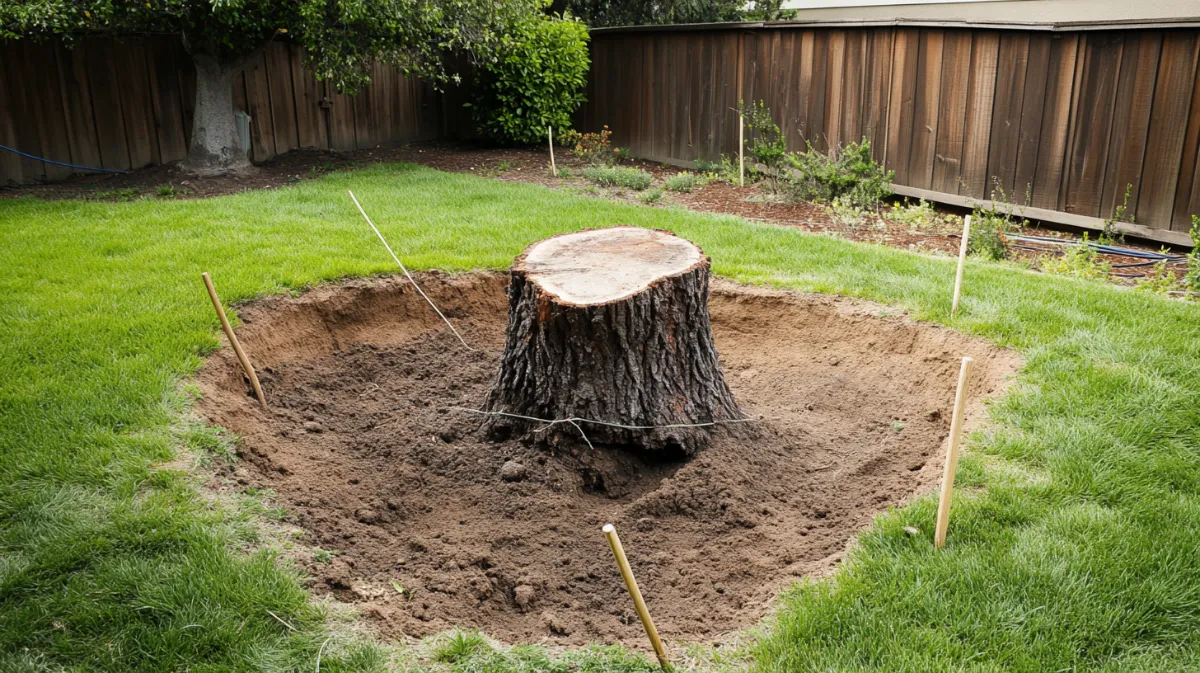
- We dig around the stump to expose the main roots, cutting through them as we go.
- We lift out the stump and root ball, by machine or by hand, depending on the size and how we can get to it.
- We pull the larger leftover roots from the hole.
- We backfill with soil and compact it in layers, or leave the hole open for your contractor if that's the plan.
Big stumps can mean heavy equipment on your property, so we'll talk through access and how to protect the yard before we start.
What full removal costs compared with grinding
Removal is more work, so it costs more. Nationally, digging out a stump runs about $175 to $516, against roughly $130 to $440 to grind the same one. Large oaks and redwoods with big root systems, tight access and rocky clay all push the price up. Hauling the stump off is part of the job, and a big one weighs more than most people expect. If you're already building, the excavation contractor on site may be able to handle part of the work, and we're glad to coordinate with your builder so nothing gets done twice.
Managing a property with several stumps to clear? Our commercial and HOA stump grinding page covers bigger jobs.
Common Questions
Bigger than with grinding. The hole is usually wider than the stump itself, since the main roots fan out from the base, and deep enough to clear the root crown. We backfill and compact it, or leave it open if your contractor is about to dig there anyway. Expect some torn-up lawn around the work area. Grass seed covers that within a few weeks.
Usually, yes. Stumps right against a foundation, fence or wall need more care, since the roots may run underneath. Near structures we dig by hand and cut roots instead of pulling them, so nothing gets lifted or cracked. If roots have grown under the foundation, we'll show you what we find and tell you whether it's worth calling your builder or engineer before we go further.
Before. Clearing the stump and root ball early lets your builder grade and pour footings on solid ground. Working around a stump during construction usually costs more, in time and in extra equipment trips. If you have a building schedule, call us as soon as the tree is down, and we'll fit the removal in ahead of the excavation.